
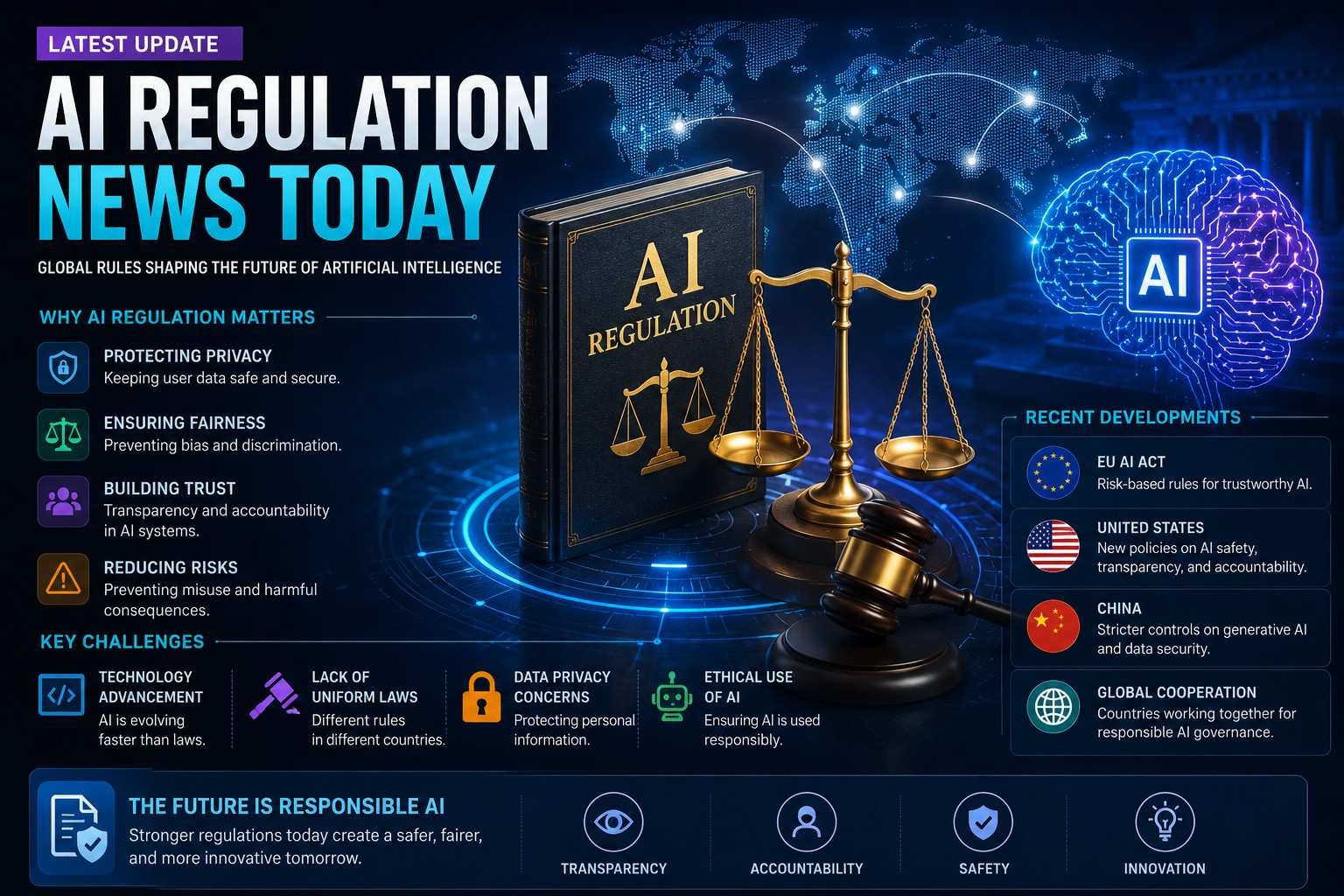
Artificial intelligence is moving faster than most governments expected. New AI tools now create videos, automate jobs, analyze personal data, and even influence elections. Because of this rapid growth, AI regulation news today has become one of the most searched topics worldwide.
Countries are now racing to create rules that protect users without slowing innovation. From the European Union’s AI Act to new U.S. policies and China’s strict AI controls, the global regulatory landscape is changing almost every month.
This guide explains the latest AI laws, what they mean for businesses and users, and why these regulations could shape the future of technology for years to come.
Why AI Regulation Is Becoming a Global Priority
Artificial intelligence brings major opportunities, but it also creates serious risks. Governments are worried about misinformation, deepfakes, privacy violations, job losses, and unsafe AI systems.
Recent AI regulation news today shows that lawmakers want stronger oversight before AI becomes too powerful to control.
Key Reasons Governments Want AI Rules
- Protection against fake AI-generated content
- Better privacy and data security
- Prevention of biased AI decisions
- Transparency in AI-generated outputs
- Safety standards for advanced AI systems
- Protection of children and vulnerable users
Many experts believe AI regulation will become as important as internet regulation was in the early 2000s.
Latest AI Regulation News Today Around the World
Countries are taking different approaches to AI governance. Some focus on innovation, while others prioritize strict control and user protection.
European Union Expands the AI Act
The European Union remains the global leader in AI regulation. The EU AI Act is now entering implementation phases across member states.
The law classifies AI systems by risk level:
- Minimal risk
- Limited risk
- High risk
- Unacceptable risk
High-risk AI tools used in healthcare, education, hiring, banking, and law enforcement face strict compliance requirements.
What Makes the EU AI Act Important?
The law requires companies to:
- Explain how AI systems work
- Disclose AI-generated content
- Protect user privacy
- Monitor harmful outcomes
- Conduct safety assessments
Companies that violate the rules could face billions in fines.
The EU’s approach is influencing lawmakers in many other countries, including Canada, Brazil, and Australia.
United States AI Regulation Updates
The United States still does not have one unified federal AI law. Instead, different agencies are creating separate AI policies.
Recent AI regulation news today in the U.S. focuses on:
- AI transparency standards
- Deepfake election protections
- Copyright issues involving AI-generated content
- AI safety testing requirements
White House AI Executive Actions
The U.S. government recently introduced executive measures requiring developers of powerful AI systems to share safety test results with regulators.
Key areas include:
- National security
- Consumer protection
- Cybersecurity risks
- Worker protections
Several states, including California and New York, are also drafting their own AI legislation.
China’s Strict AI Control Strategy
China has one of the toughest AI regulatory systems in the world. The government closely monitors generative AI platforms and online algorithms.
Main Chinese AI Rules
China requires companies to:
- Register AI services with regulators
- Remove harmful or politically sensitive content
- Clearly label AI-generated media
- Follow strict cybersecurity standards
This approach gives the government stronger control over AI development compared to Western countries.
However, critics argue that excessive regulation could limit innovation and freedom of expression.
How AI Regulation Affects Businesses
Companies using AI now face increasing legal and operational responsibilities. Businesses can no longer deploy AI tools without considering compliance risks.
Industries Most Affected
Several sectors face higher scrutiny:
| Industry | Main AI Concerns |
| Healthcare | Patient safety and bias |
| Finance | Fraud detection and fairness |
| Education | Student data privacy |
| Hiring | Discrimination risks |
| Media | Deepfakes and misinformation |
| Retail | Consumer tracking |
Organizations must now invest in:
- AI governance teams
- Compliance audits
- Data protection systems
- Human oversight processes
Businesses that ignore these requirements could face lawsuits, fines, or reputational damage.
AI Regulation and Privacy Concerns
One of the biggest topics in AI regulation news today is data privacy.
AI systems often train on massive amounts of internet data, including personal information. Regulators are questioning whether companies obtained that data legally.
Major Privacy Issues
Common concerns include:
- Unauthorized data scraping
- Facial recognition misuse
- AI surveillance systems
- Voice cloning risks
- Biometric data collection
Privacy regulators worldwide are now investigating several AI companies over data practices.
This trend is pushing organizations to improve transparency and user consent policies.
Deepfakes Are Driving New AI Laws
Deepfake technology has become a major political and security concern.
AI-generated videos and audio can now imitate real people with shocking accuracy. Governments fear this technology could manipulate elections, spread scams, and damage public trust.
New Rules Targeting Deepfakes
Many countries are introducing laws requiring:
- Labels on AI-generated media
- Criminal penalties for harmful deepfakes
- Election-related content restrictions
- Watermarking technology
As elections approach in several major countries, deepfake regulation is expected to become even stricter.
Open-Source AI vs Regulated AI
Another growing debate involves open-source AI models.
Some experts believe open-source AI promotes innovation and transparency. Others worry it could allow dangerous tools to spread without oversight.
Arguments Supporting Open-Source AI
Supporters say it:
- Encourages innovation
- Reduces monopoly power
- Improves transparency
- Helps researchers identify risks
Concerns About Open AI Models
Critics warn that open models could be used for:
- Cybercrime
- Misinformation campaigns
- Malware generation
- Bioweapon research
Governments are now discussing whether advanced open-source models should face additional restrictions.
AI Regulation News Today and Copyright Battles
Copyright law is another major issue in the AI industry.
Artists, publishers, and creators claim that AI companies trained models using copyrighted material without permission.
Key Copyright Questions
Courts are currently debating:
- Whether AI training counts as fair use
- Who owns AI-generated content
- Whether creators deserve compensation
- How licensing systems should work
These legal battles could redefine digital copyright laws globally.
Publishers and media companies are also pushing for stronger licensing agreements with AI developers.
The Role of AI Safety Testing
AI safety testing is becoming mandatory in several regions.
Governments want developers to prove their systems are safe before public release.
What AI Safety Tests Include
Regulators may require testing for:
- Bias and discrimination
- Harmful outputs
- Cybersecurity vulnerabilities
- Misinformation risks
- Hallucination rates
Safety testing is especially important for powerful generative AI models used at scale.
How Smaller Businesses Can Prepare for AI Regulations
Many small companies assume AI compliance only affects tech giants. That is no longer true.
Any business using AI tools may eventually face legal responsibilities.
Practical Steps for Compliance
Businesses should:
- Audit current AI tools
- Review data collection practices
- Add human oversight
- Create AI usage policies
- Monitor future regulations
- Train employees on responsible AI
Starting early can reduce future compliance costs and legal risks.
AI Regulation News Today: What Experts Predict Next
Experts believe global AI regulation will continue expanding through 2026 and beyond.
Future Trends to Watch
Several developments are expected:
- Global AI safety standards
- International AI treaties
- Stronger deepfake laws
- AI labeling requirements
- Higher fines for violations
- Mandatory transparency reports
Some analysts predict that AI regulation could eventually become as comprehensive as financial regulation.
The challenge will be balancing innovation with public safety.
How AI Regulations Could Affect Everyday Users
Most people think AI laws only affect tech companies, but consumers will also notice major changes.
Expected Changes for Users
Future regulations may bring:
- More transparency online
- Labels for AI-generated content
- Better privacy protections
- Safer AI chatbots
- Reduced misinformation
However, stricter rules could also slow the release of new AI products in some regions.
Frequently Asked Questions
What is the latest AI regulation news today?
The latest AI regulation news today includes updates on the EU AI Act, U.S. AI safety measures, deepfake legislation, and global efforts to regulate generative AI platforms.
Why are governments regulating AI?
Governments want to reduce risks related to misinformation, privacy violations, cybercrime, discrimination, and unsafe AI systems.
Which country has the strictest AI laws?
China currently has some of the strictest AI controls, especially regarding online content and generative AI services.
How does the EU AI Act work?
The EU AI Act classifies AI systems based on risk levels and imposes stronger compliance rules on high-risk applications.
Will AI regulations slow innovation?
Some experts believe strict regulations may slow development, while others argue that clear rules increase trust and long-term innovation.
How can businesses stay compliant with AI laws?
Businesses should audit AI systems, improve transparency, protect user data, and monitor changing regulations worldwide.
Conclusion
AI is transforming nearly every industry, and governments are moving quickly to catch up. The rapid rise of deepfakes, data privacy concerns, and advanced generative AI tools has made regulation unavoidable.
The biggest takeaway from AI regulation news today is clear: the future of artificial intelligence will not be shaped by technology alone. Laws, ethics, transparency, and public trust will play an equally important role.
Businesses, creators, and everyday users should stay informed because AI regulations will continue evolving across the globe. Those who adapt early will be better prepared for the next phase of the AI revolution.
