
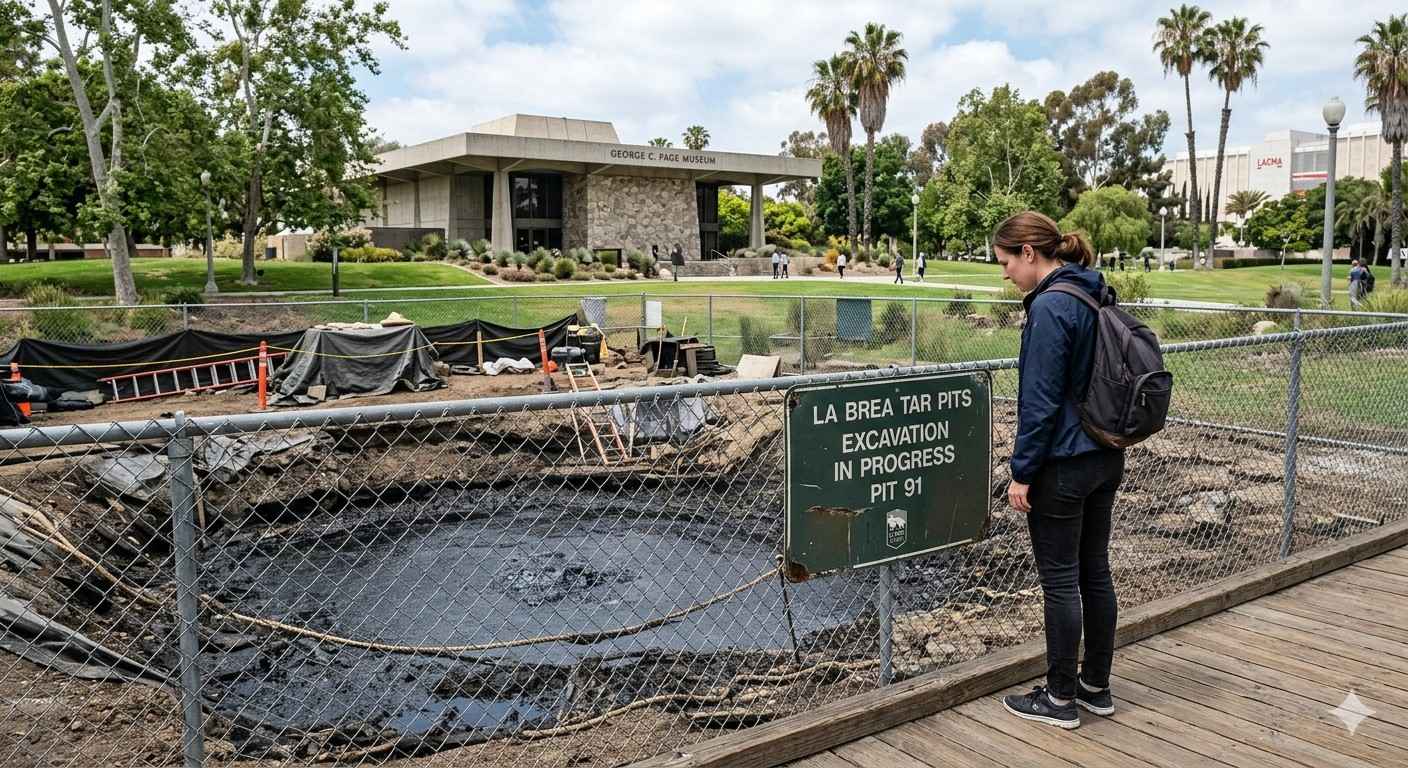
Imagine walking through the middle of Los Angeles and finding bubbling pools of natural asphalt that have preserved Ice Age animals for tens of thousands of years.
That’s exactly what makes the La Brea Tar Pits one of the most extraordinary paleontological sites on Earth. Located in the heart of Los Angeles, California, this famous fossil site has revealed millions of fossils from mammoths, saber-toothed cats, dire wolves, giant sloths, and hundreds of other prehistoric species.
Whether you’re planning a visit, researching Ice Age history, or simply curious about how animals became trapped in tar, this guide covers everything you need to know about the La Brea Tar Pits in 2026 and beyond.
What Are the La Brea Tar Pits?
The La Brea Tar Pits are natural asphalt seeps where sticky petroleum has risen from underground for tens of thousands of years. Despite the name, the pits aren’t actually made of tar. They contain natural asphalt formed from crude oil that migrated to the surface.
Over thousands of years, animals became trapped in these sticky deposits. Predators were often attracted to struggling prey, causing multiple species to become trapped in the same location.
This unique process created one of the richest collections of Ice Age fossils ever discovered.
Today, the site serves as both:
- An active scientific research center
- A public museum and educational attraction
- One of the world’s most important fossil excavation sites
Scientists have recovered millions of fossils from the area, making the La Brea Tar Pits a cornerstone of paleontology research.
Why Are the La Brea Tar Pits So Famous?
Many fossil sites contain bones from a limited number of animals. The La Brea Tar Pits are different because they preserve entire ecosystems.
Researchers have uncovered:
- Mammoths
- Mastodons
- Saber-toothed cats
- Dire wolves
- American lions
- Giant ground sloths
- Ancient horses
- Camels
- Birds
- Plants
- Insects
The site provides an unusually detailed picture of life in Southern California during the Pleistocene Epoch, often called the Ice Age.
More than 2 million fossil specimens have been recovered, making it one of the largest collections of Ice Age fossils in the world.
The Science Behind the La Brea Tar Pits
How Did Animals Get Trapped?
The process was surprisingly simple.
Natural asphalt seeped to the surface and became covered by dust, leaves, or water. Animals often couldn’t recognize the danger.
Once trapped, escaping became nearly impossible.
Large herbivores would struggle, attracting predators and scavengers. Those animals sometimes became trapped as well.
This explains why scientists have discovered such high numbers of carnivore fossils at the site.
Why Are the Fossils So Well Preserved?
The asphalt created an oxygen-poor environment that slowed decomposition.
As a result:
- Bones remained intact
- Teeth stayed remarkably preserved
- Plant material survived
- Ancient DNA sometimes remained detectable
The preservation quality makes the La Brea Tar Pits invaluable for modern scientific research.
Most Famous Animals Found at the La Brea Tar Pits
Saber-Toothed Cats
The saber-toothed cat (Smilodon fatalis) is perhaps the site’s most iconic animal.
Features included:
- Long canine teeth
- Powerful forelimbs
- Stocky body structure
- Ambush hunting behavior
Thousands of saber-toothed cat fossils have been discovered, allowing scientists to study their anatomy in exceptional detail.
Dire Wolves
Before becoming popular through modern entertainment, dire wolves were a real species.
The La Brea Tar Pits contain one of the largest collections of dire wolf remains ever found.
Researchers have recovered thousands of specimens, helping scientists understand their evolution, behavior, and extinction.
Columbian Mammoths
Massive Columbian mammoths roamed Southern California during the Ice Age.
One particularly famous specimen, nicknamed “Zed,” is among the most complete mammoth discoveries from the site and is expected to become a major exhibit in future museum displays.
Giant Ground Sloths
These enormous herbivores could reach impressive sizes and represent one of the most fascinating extinct mammals discovered at the site.
Visiting the La Brea Tar Pits Today
The La Brea Tar Pits are located in Los Angeles near Museum Row.
Visitors traditionally enjoy:
- Outdoor tar pit displays
- Fossil exhibits
- Active excavation areas
- Paleontology laboratories
- Educational programs
- Family-friendly activities
One of the most popular experiences is watching scientists work on real fossils in public laboratories.
This rare opportunity allows visitors to see science happening in real time. Scientists often describe the site as one of the few places where the entire fossil discovery process is visible to the public.
Current Renovation Project (2026–2028)
Major Changes Coming to the La Brea Tar Pits
The La Brea Tar Pits are currently undergoing the largest transformation in their history.
The renovation project includes:
- Museum modernization
- New visitor pathways
- Enhanced research facilities
- Improved accessibility
- Expanded educational spaces
- Updated exhibits
- New landscaping
The project is valued at approximately $240 million and represents the first major overhaul since the museum opened in 1977.
What Will Be New?
Plans include:
- Better connections between indoor and outdoor exhibits
- Expanded fossil research areas
- New public gathering spaces
- Modernized exhibition halls
- Enhanced visitor experiences
The redesign aims to make the site more accessible while preserving its scientific importance.
When Will It Reopen?
Current plans anticipate reopening major facilities around 2028 after renovation work is completed.
What Makes the La Brea Tar Pits Unique?
An Active Fossil Site in a Major City
Few fossil sites exist in the middle of a major metropolitan area.
The La Brea Tar Pits sit in the heart of Los Angeles, surrounded by museums, businesses, and neighborhoods.
Scientists continue making discoveries today, proving that the site remains an active research location rather than just a historical attraction.
Ongoing Excavations
Excavation projects continue to uncover:
- New species
- Better-preserved specimens
- Environmental evidence
- Climate records
Each discovery helps researchers understand ancient ecosystems and extinction events.
Insights Into Climate Change
The fossils provide evidence of how ecosystems responded to environmental changes during the Ice Age.
Scientists use this information to understand better:
- Species adaptation
- Extinction patterns
- Climate shifts
- Ecosystem resilience
These lessons remain highly relevant today.
Educational Value of the La Brea Tar Pits
The La Brea Tar Pits offer more than fascinating fossils.
Visitors learn about:
- Evolution
- Geology
- Paleontology
- Climate science
- Extinction events
- Scientific research methods
The site serves as an outdoor classroom for students, families, and researchers from around the world.
This combination of public education and active research is one reason the location remains internationally respected.
Interesting Facts About the La Brea Tar Pits
Here are some fascinating facts many visitors don’t know:
- “La Brea” means “the tar” in Spanish, making “La Brea Tar Pits” technically “The Tar Tar Pits.”
- Fossils continue to be discovered today.
- Natural asphalt still bubbles to the surface.
- Millions of fossils have been recovered.
- The site preserves both plants and animals.
- It contains one of the world’s largest collections of Ice Age predator fossils.
- Scientists have studied the area for more than a century.
FAQs About the La Brea Tar Pits
Are the La Brea Tar Pits real?
Yes. The La Brea Tar Pits are real natural asphalt seeps located in Los Angeles, California.
Why are they called tar pits if they contain asphalt?
The name became popular before scientists fully understood the material. Technically, the pits contain natural asphalt rather than true tar.
Can you still see tar bubbling today?
Yes. Visitors can still observe active asphalt seeps throughout the park.
What is the most famous fossil found at the La Brea Tar Pits?
Saber-toothed cats, dire wolves, and Columbian mammoths are among the site’s most famous discoveries.
How old are the fossils?
Many fossils date between 10,000 and 50,000 years old, though some are even older.
Are scientists still excavating fossils?
Yes. The site remains an active paleontological research center where discoveries continue to be made.
Is the museum currently under renovation?
Yes. A major renovation project is underway and is expected to continue through approximately 2028.
Conclusion
The La Brea Tar Pits are far more than a tourist attraction. They represent one of the world’s most important windows into Ice Age life.
From saber-toothed cats and dire wolves to mammoths and giant sloths, the site has transformed our understanding of prehistoric ecosystems. Its combination of active research, public education, and extraordinary fossil preservation makes it unique among natural history destinations.
With major renovations planned through 2028, the future of the La Brea Tar Pits looks as exciting as its past. Whether you’re a traveler, student, scientist, or history enthusiast, this remarkable site offers an unforgettable look at a world that disappeared thousands of years ago, yet still reveals its secrets today.
