
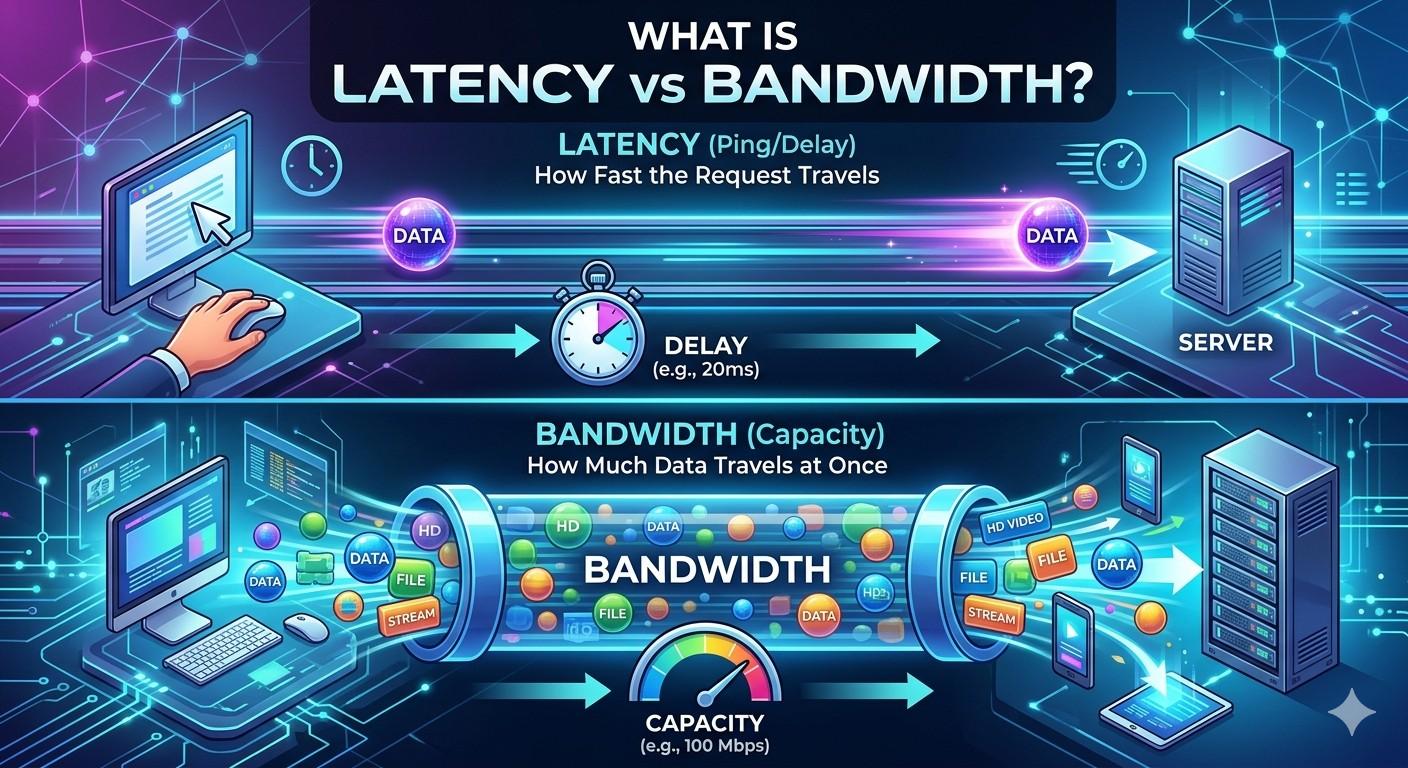
When people experience slow internet, they often assume they need more bandwidth. However, the real problem may be latency. Understanding what is latency vs bandwidth is essential because both affect network performance in different ways.
Bandwidth determines how much data can travel across a network at one time, while latency measures how long data takes to travel from one point to another. A connection can have high bandwidth and still feel slow if latency is high.
In this guide, you’ll learn the difference between latency and bandwidth, how they impact internet performance, and which one matters most for activities like gaming, streaming, video conferencing, and cloud computing.
Why Understanding Latency vs Bandwidth Matters
Many internet users focus only on download speeds. Internet service providers often advertise bandwidth in Mbps or Gbps, making it seem like bandwidth is the only factor that matters.
In reality:
- High bandwidth allows more data to move simultaneously.
- Low latency ensures data arrives quickly.
- Good network performance requires both.
Understanding what is latency vs bandwidth helps you troubleshoot network issues more effectively and choose the right internet plan for your needs.
What Is Bandwidth?
Bandwidth refers to the maximum amount of data that can be transmitted over a network connection during a specific period.
It is typically measured in:
- Mbps (Megabits per second)
- Gbps (Gigabits per second)
Think of bandwidth as the width of a highway.
A wider highway can accommodate more cars at the same time. Similarly, higher bandwidth allows more data packets to travel simultaneously.
Examples of Bandwidth
| Activity | Typical Bandwidth Requirement |
| Less than 1 Mbps | |
| HD Streaming | 5–10 Mbps |
| 4K Streaming | 25+ Mbps |
| Video Conferencing | 3–8 Mbps |
| Online Gaming | 3–10 Mbps |
| Large File Downloads | 100+ Mbps preferred |
A household with multiple users streaming videos, attending video meetings, and downloading files simultaneously benefits from higher bandwidth.
What Is Latency?
Latency is the time it takes for data to travel from a source to a destination and back.
It is usually measured in milliseconds (ms).
Think of latency as travel time.
Even on a six-lane highway, a car still needs time to reach its destination. Likewise, data requires time to travel across networks.
Examples of Latency
- Excellent latency: Under 20 ms
- Good latency: 20–50 ms
- Acceptable latency: 50–100 ms
- Poor latency: Over 100 ms
Low latency means faster response times and a more responsive user experience.
Latency vs Bandwidth: The Core Difference
Understanding what is latency vs bandwidth becomes easier with a simple comparison.
| Feature | Latency | Bandwidth |
| Measures | Delay | Capacity |
| Unit | Milliseconds (ms) | Mbps or Gbps |
| Focus | Speed of response | Amount of data |
| Affects | Real-time activities | Large data transfers |
| Lower Is Better? | Yes | No |
| Higher Is Better? | No | Yes |
In simple terms:
- Latency = How fast data starts moving.
- Bandwidth = How much data can move at once.
H2: What Is Latency vs Bandwidth in Real-World Scenarios?
Different online activities rely on latency and bandwidth in different ways.
H3: Online Gaming
Gaming depends heavily on latency.
Players need immediate communication between their device and game servers.
Effects of high latency:
- Lag
- Delayed actions
- Rubber-banding
- Missed shots
Most online games use relatively little bandwidth but require low latency.
Example:
- Bandwidth: 10 Mbps
- Latency: 15 ms
This setup often performs better for gaming than:
- Bandwidth: 1 Gbps
- Latency: 200 ms
H3: Video Streaming
Streaming platforms require more bandwidth than low latency.
For example:
- HD video may need 5 Mbps
- 4K video may need 25 Mbps or more
Latency matters initially when starting a video, but bandwidth determines overall playback quality.
If bandwidth is insufficient, users experience:
- Buffering
- Lower resolution
- Playback interruptions
H3: Video Conferencing
Applications like video meetings require both bandwidth and latency.
High latency can cause:
- Audio delays
- People talking over each other
- Communication difficulties
Low bandwidth can result in:
- Blurry video
- Frozen screens
- Poor audio quality
For smooth meetings, organizations should prioritize both.
H3: Cloud Applications
Modern businesses rely on cloud-based software.
Examples include:
- Customer relationship management systems
- Project management tools
- Cloud storage platforms
- Collaboration software
Cloud applications often feel slow when latency is high, even if bandwidth is abundant.
The Highway Analogy: A Simple Way to Understand It
One of the best explanations for what is latency vs bandwidth is the highway analogy.
Imagine:
- Bandwidth = Number of lanes on a highway
- Latency = Travel time from start to destination
Scenario 1:
A 12-lane highway with heavy travel distance.
- High bandwidth
- High latency
Many cars can travel, but it still takes time to arrive.
Scenario 2:
A 2-lane road with a very short distance.
- Low bandwidth
- Low latency
Cars arrive quickly but fewer cars fit on the road.
The ideal situation is:
- Wide highway
- Short travel distance
In networking terms:
- High bandwidth
- Low latency
What Causes High Latency?
Several factors increase network latency.
Physical Distance
Data traveling across continents naturally takes longer.
For example:
- Local server: 10–20 ms
- International server: 100–300 ms
Network Congestion
Busy networks create delays.
Common causes include:
- Peak internet usage hours
- Overloaded routers
- Crowded public Wi-Fi
Server Performance
Slow servers increase response times regardless of connection speed.
Routing Issues
Data often passes through multiple devices before reaching its destination.
Poor routing increases latency.
Wireless Interference
Wi-Fi signals can suffer from:
- Walls
- Electronic devices
- Signal overlap
This can add latency and packet loss.
What Causes Bandwidth Limitations?
Bandwidth bottlenecks often occur because of:
Internet Plan Restrictions
Some service plans simply provide limited bandwidth.
Too Many Connected Devices
Smart homes may include:
- TVs
- Phones
- Laptops
- Security cameras
- Smart speakers
All devices compete for bandwidth.
Large Downloads
Massive file transfers can consume available bandwidth and slow other activities.
Network Hardware
Older routers and switches may limit network capacity.
Which Is More Important: Latency or Bandwidth?
The answer depends on your use case.
Latency Is More Important For:
- Online gaming
- Voice calls
- Video conferencing
- Remote desktop access
- Financial trading
- Interactive cloud applications
Bandwidth Is More Important For:
- Streaming movies
- Downloading files
- Uploading videos
- Cloud backups
- Large data transfers
Both Matter For:
- Remote work
- Online learning
- Hybrid cloud environments
- Business communications
How to Measure Latency and Bandwidth
Measuring Latency
Use tools such as:
- Ping tests
- Network monitoring software
- Speed test services
Latency appears as a ping value measured in milliseconds.
Measuring Bandwidth
Bandwidth is measured using:
- Internet speed tests
- Network analytics tools
- ISP performance reports
Results typically show:
- Download speed
- Upload speed
How to Reduce Latency
If latency is your problem, try these solutions:
Use a Wired Connection
Ethernet connections are generally more stable than Wi-Fi.
Choose Nearby Servers
Many online games allow server selection.
Selecting the nearest server lowers latency.
Upgrade Networking Equipment
Modern routers often provide better performance and lower delays.
Close Background Applications
Apps using network resources can increase delays.
Optimize Network Routing
Businesses can use content delivery networks (CDNs) and optimized routing solutions.
How to Improve Bandwidth
To increase available bandwidth:
Upgrade Your Internet Plan
Higher-tier plans provide greater capacity.
Use Modern Routers
Newer hardware supports faster wireless standards.
Manage Network Traffic
Prioritize important applications using Quality of Service (QoS) settings.
Reduce Simultaneous Heavy Usage
Avoid multiple large downloads during important online activities.
Common Misconceptions About Latency and Bandwidth
More Bandwidth Always Means Faster Internet
Not necessarily.
A 1 Gbps connection with 200 ms latency may feel slower than a 100 Mbps connection with 15 ms latency for interactive tasks.
Ping Only Matters for Gamers
False.
Video calls, cloud applications, and remote work tools all benefit from low latency.
Bandwidth and Latency Are the Same Thing
They measure entirely different aspects of network performance.
Bandwidth measures capacity.
Latency measures delay.
Future Trends in Network Performance (2025 and Beyond)
As internet infrastructure evolves, both latency and bandwidth continue improving.
Key developments include:
- Fiber-optic expansion
- Edge computing
- Advanced Wi-Fi standards
- Satellite internet improvements
- AI-powered network optimization
- 5G and emerging 6G technologies
These innovations aim to provide:
- Higher bandwidth
- Lower latency
- Better user experiences
For businesses and consumers alike, understanding what is latency vs bandwidth remains critical when evaluating network performance.
Frequently Asked Questions
What is the difference between latency and bandwidth?
Latency measures how long data takes to travel between devices, while bandwidth measures how much data can be transmitted simultaneously.
Is low latency better than high bandwidth?
For gaming, video calls, and real-time applications, low latency is often more important than extremely high bandwidth.
What is a good latency for gaming?
Most gamers aim for latency below 50 milliseconds, with under 20 milliseconds considered excellent.
Can high bandwidth reduce latency?
Not directly. Increasing bandwidth improves capacity but does not automatically reduce delay.
Does fiber internet improve both latency and bandwidth?
Yes. Fiber connections generally offer higher bandwidth and lower latency than many traditional broadband technologies.
Why is my internet fast but still lagging?
You may have sufficient bandwidth but poor latency, network congestion, packet loss, or server-related issues.
Conclusion
Understanding what is latency vs bandwidth is essential for diagnosing internet performance problems and making smarter networking decisions.
Bandwidth determines how much data your connection can handle, while latency determines how quickly data responds. A fast, responsive internet experience depends on balancing both factors.
If you stream large amounts of content, bandwidth should be a priority. If you game online, attend video meetings, or use cloud applications, latency may be even more important.
The best network experience comes from combining high bandwidth with low latency, ensuring both capacity and responsiveness for today’s connected world.
